The Singleton house bombing
Down Cemetery RoadThe Singleton house bombing turns a family home into a public landmark of destruction and, for Sarah Trafford, exposes how badly her assumptions about Dinah Singleton have failed. The blast’s mechanics and perpetrators are not established in the available account; what remains in view is the ruined house, Sarah’s encounter at its edge, and the emotional consequences that surface when she later tries to explain what happened.
The Ruin and Its Setting
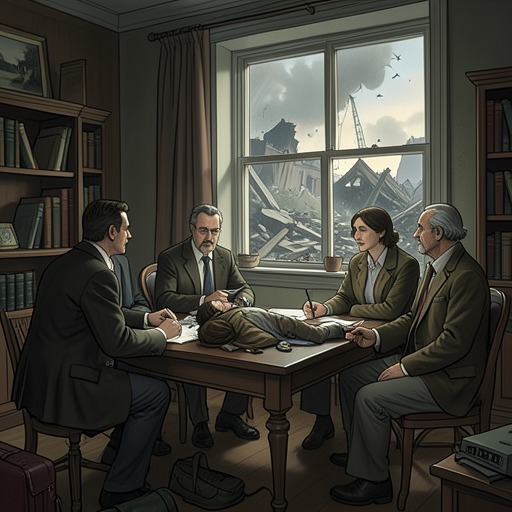
The house stood near a bridge and had become familiar to the local community in its damaged state. Boarding marked it as a place people should avoid, but the barrier was poorly constructed enough that anyone mildly curious could get inside. From the bridge, the wreckage was visible: bricks and mortar, broken pipes, shards of porcelain, and glass scattered among the remains of domestic life. A battered fish-slice and a frayed lampshade were among the household objects left poking through the rubble, while portable items of even modest value had already been carried off.
The damage was not simply hidden behind a secure perimeter or quickly cleared away. Children treated the blown house as a landmark; adults grumbled that it should have been dealt with by then. That lingering visibility made the ruin part of the neighborhood’s everyday landscape, even as it marked a home that had been violently destroyed.
Sarah at the Site
One afternoon, returning across the bridge, Sarah noticed the devastated house before she noticed a child nearby. When she finally saw the child, she understood that the child was not Dinah. The overalls, sweets, and fondness for feeding swans belonged in her mistaken picture of Dinah, but the child before her was someone else. Sarah’s recognition came too late to undo what had already happened.
The discovery recasts Sarah’s search as a painful misapprehension rather than a successful encounter. She had believed she had found Dinah, or at least recognized her, when in fact she had attached Dinah’s identity to another child. The wreckage supplies the setting for this recognition, while Sarah’s belated sight of the child gives the aftermath its personal force.
Recollection and Consequences
Later, when Zoë Boehm challenges Sarah over her sense of guilt, Sarah begins to explain the bomb by recalling that it had gone off up the road and pushed a house into the river. Her account is brief and emotionally difficult to continue: anger gives way to weariness and near tears as she tries to put the event into words. The memory is therefore presented not as a detached report of damage but as part of Sarah’s struggle to face what she has done and what she believes she may have failed to do.
Another later conversation places Sarah on the bridge after Thomas Singleton was killed. That detail associates the bridge with the wider sequence of violence and loss surrounding the Singleton family, but it does not establish the exact timing or circumstances of the bombing. The evidence likewise does not identify who planted the bomb or specify its construction. The event’s clearest consequences are the destruction of the home, the enduring neighborhood ruin, and Sarah’s painful realization that her supposed sighting of Dinah was mistaken.